Indonesia· Asia
Sep 11 – Sep 12, 2026
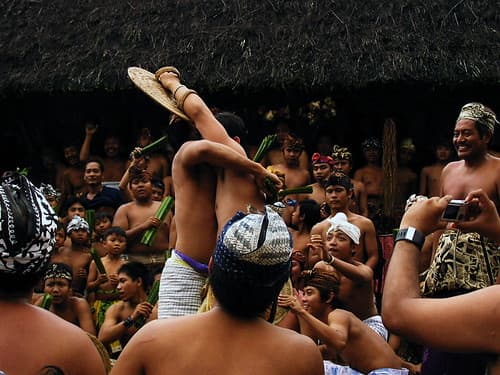
Young men duel with thorned pandan leaves and rattan shields as an offering to the god Indra.
Mekare-kare, the pandanus war, is the signature rite of Tenganan's month-long ritual season, usually falling in June or July by the village's own calendar. Pairs of young men and boys face off in short, fierce duels: each holds a tight bundle of pandan leaves edged with thorns as a weapon and a coiled rattan shield to parry, and they grapple and rake the spiked leaves across each other's backs while a gamelan selonding plays and an elder referees. The bouts are brief, the cuts are real, and afterwards the wounds are dressed with a turmeric-and-vinegar antiseptic; there is no enmity in it and no revenge — opponents embrace when it is done. The duel is an offering to Indra, the god of war and of the village's founding myth, and a test and display of courage by which Tenganan's young men take their place in the community. It runs alongside other rites of the season, including the ferris-wheel-like turning of unmarried girls on a hand-cranked wooden wheel, and it is bound up with the gringsing cloth the village alone weaves — a double-ikat textile, its threads dyed before weaving over a span of years, worn for the ritual and believed to protect against ill. Tenganan governs itself by an unbroken adat that predates the Hindu kingdoms of Bali, and the pandanus war is the most visible expression of a village that has held its own order for a very long time. Outsiders may watch, but they enter a living, sacred ceremonial space, not a show.
Drawn up by the host community. Please read in full before requesting an invitation.
Witnessed. The pandanus war is open to respectful visitors, who enter Tenganan by donation and watch from the public areas; a guide helps with the adat and timing. The village remains an active sacred and residential space with strict customary rules.
Modest clothing covering shoulders and knees, with a sash (selendang) tied at the waist as for any Balinese temple or ceremony. Practical footwear for village paths.
Photography of the public duels is generally permitted, but ask before close portraits and respect any rite the village closes to cameras. Follow your guide and the village adat.
Enter by the village donation, keep to the spectator areas around the pavilion, and don't interrupt the duels or the gamelan. Treat the gringsing weavers and the elders with deference, and buy genuine cloth directly if you wish to.
Balinese and Indonesian; guides speak English.
Tropical heat and humidity over a daytime ceremony; manage sun and water. The duel's cuts are the participants' own; spectators are not at risk. Rural east Bali has basic medical care.
East Bali in June–July is warm and humid with strong sun: light modest clothing, a hat, sunscreen and water. A Balinese sash (selendang) at the waist is the respectful mark of a guest at a ceremony — buy or borrow one. Indonesian rupiah in cash for the village donation and the gringsing weavers. Sturdy sandals for the village paths.
Inside the walled village, the duels take place on a raised pavilion so the community can see; the gamelan selonding rings out, elders direct the pairs, and the young men step up two at a time to grapple and rake the thorned leaves down each other's backs. It is fast, physical and bloody in a matter-of-fact way — and immediately followed by embraces and the dressing of cuts, with no anger in it. Around the duels the village goes about its ritual day in gringsing cloth. You watch as a guest among residents, on the village's terms.
The pandanus duel and the cloth that protects the village