Peru· Americas
Jul 11 – Jul 12, 2026
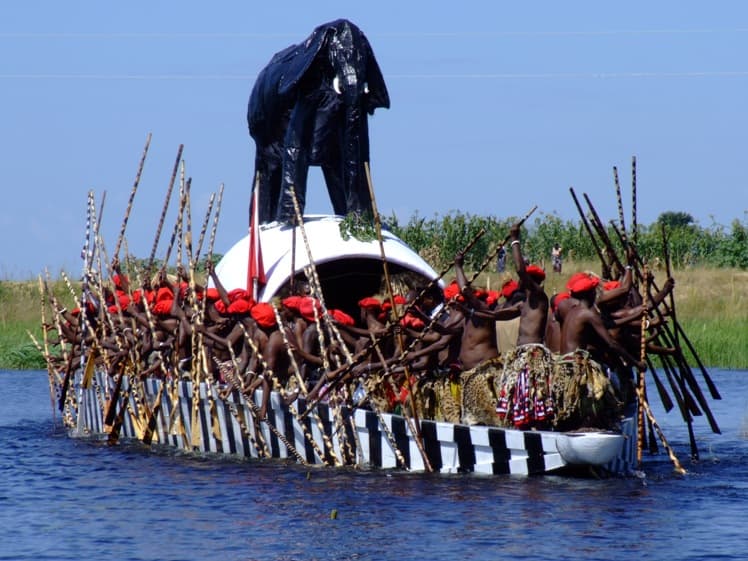
The Litunga is paddled from Lealui to Limulunga aboard the Nalikwanda, a black-and-white barge crowned with a carved elephant.
When the Zambezi floods the Barotse Plain, the Litunga leaves his rainy-season palace at Lealui and is paddled to the dry-season capital at Limulunga. He travels aboard the Nalikwanda, a great barge painted in black and white stripes and topped with a carved elephant whose ears can be made to move; a second barge carries the Maoma royal drums, which are sounded to summon the paddlers and announce the crossing. The hundred or so paddlers — the bo-mukacaa — wear scarlet berets and skirts of animal skins and drive the barge across the open water through most of a day. The departure is timed to the flood: the Establishment will not announce a date until the water is high enough, so the ceremony is a reading of the river as much as a fixture. Along both banks, between 200,000 and a quarter of a million subjects and visitors gather to wait for the elephant to come into view. The crossing carries the kingship itself from one season to the next; it is governance performed in water, and it has anchored Lozi identity through colonial rule and into the present.
Drawn up by the host community. Please read in full before requesting an invitation.
Open to respectful visitors who follow the marshals and stay clear of the royal route. Reached via Mongu, then road or boat to Limulunga; arrange a local host, as the date is only fixed a week or two ahead.
Modest dress covering shoulders and knees. Avoid red, which belongs to the royal paddlers' uniform. Smart-casual is read as a mark of respect for the king.
Photography from the public banks is welcomed. Do not enter the water, approach the Nalikwanda, or photograph the Litunga at close range; follow the marshals without exception.
Stand where the marshals direct and let the procession and royal party pass without crowding. The crossing is the king's day, not a performance staged for visitors — patience through the long wait is itself the etiquette.
Silozi, with English widely understood in Mongu and Limulunga.
A long day standing in heat and humidity with minimal shade; pace your water and salts. This is a malaria zone at the wet season's end — bring prophylaxis and repellent.
A full day on an exposed riverbank in the hot, humid build-up to the rains: sun protection, more water than you think you need, and a hat are the non-negotiables. The ground at the landing is often wet and churned — closed shoes you don't mind muddying. Cash in kwacha for food stalls; card payment is rare.
You wait on the bank at Limulunga with a crowd that thickens through the morning. Long before the barge appears you hear the Maoma drums carrying over the water. The Nalikwanda comes slowly — the paddlers set a steady, unhurried stroke — and the carved elephant on its roof is the first thing most people can pick out. The Litunga boards in ordinary dress and disembarks in the full uniform of a British admiral, a nineteenth-century gift the Lozi absorbed into their own protocol; the change of dress is part of the spectacle. Expect heat, a very large crowd, and a long wait rewarded in a few minutes of arrival.
The Lozi king's flood migration across the Barotse Plain