Peru· Americas
Jun 16 – Jun 17, 2027
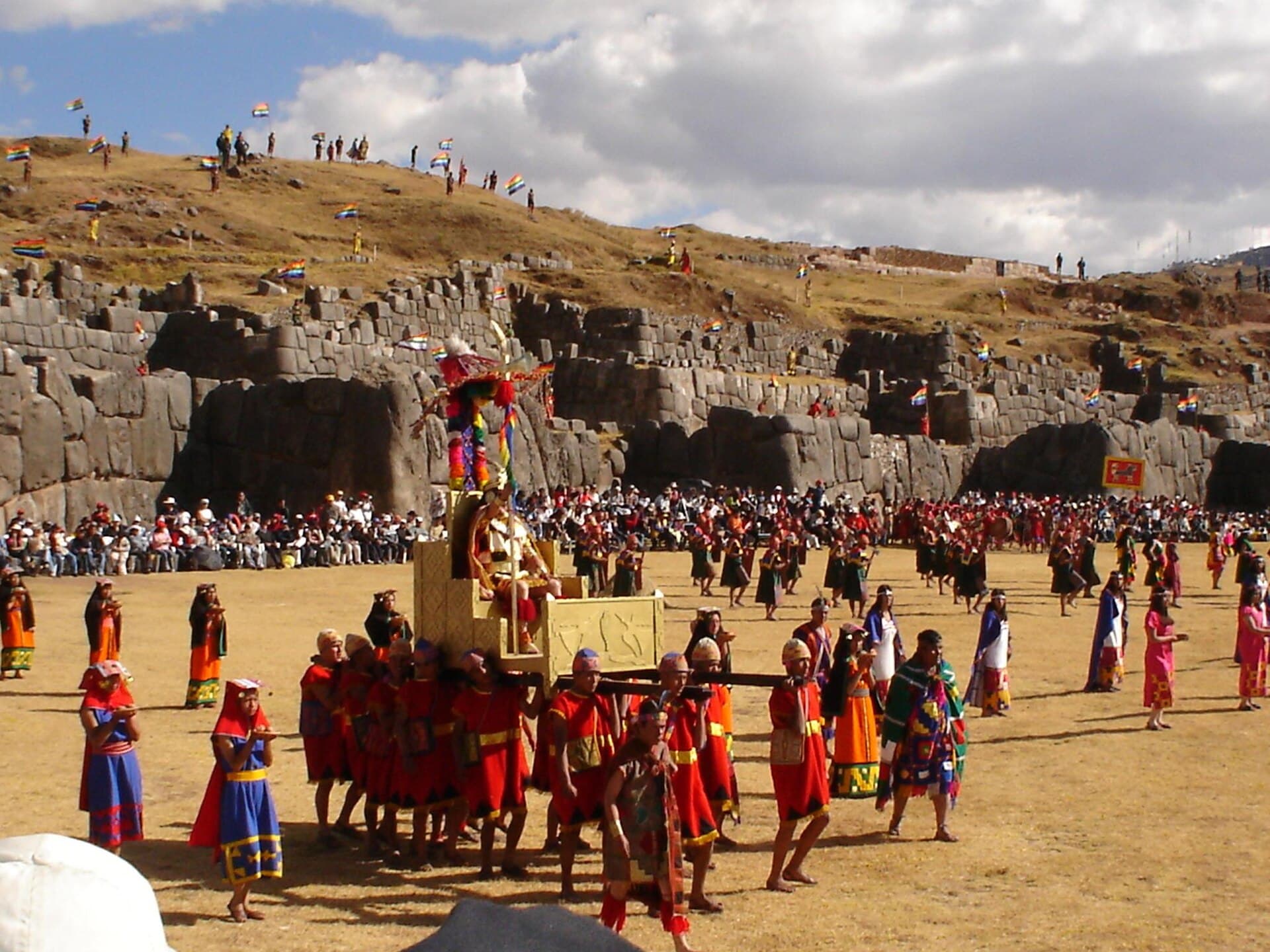
Hundreds enact the Inca solstice rite from the Qorikancha to the heights of Sacsayhuamán.
Inti Raymi unfolds on 24 June across three of Cusco's old Inca stages. It begins at the Qorikancha, the Inca sun temple over which the Spanish built a church, where the figure of the Sapa Inca invokes the rising sun; it moves to the Plaza de Armas, the old Huacaypata, for an address to the assembled nations; and it climbs to the vast esplanade of Sacsayhuamán above the city, at some 3,700 metres, for the central rite — a reconstruction of the solstice ceremony with hundreds of costumed performers, the Sapa Inca and Qoya carried on litters, processions of the four quarters of the empire, offerings, music and a staged sacrifice (a llama, symbolically, in the modern pageant) read for omens of the coming year. The whole is performed in Quechua. It is openly a reconstruction: banned by the Spanish in 1572 and dark for nearly four centuries, it was rebuilt in 1944 by Cusco intellectuals drawing on the colonial-era chronicle of the part-Inca writer Garcilaso de la Vega, as an assertion of Andean identity and pride. That history is worth holding honestly — neither dismissing the pageant as invented spectacle nor overstating an unbroken line. What is alive is real: it is the largest festival in Cusco, owned by the city, performed by its people, and woven into a wider Andean reverence for the sun and the mountains that never died. Tens of thousands fill the hillsides; ticketed stands ring the Sacsayhuamán esplanade.
Drawn up by the host community. Please read in full before requesting an invitation.
Open on the hillsides (free) or via ticketed stands on the Sacsayhuamán esplanade, sold through the city's festival company and agencies — buy well ahead. The Qorikancha and Plaza segments are public and crowded.
Practical layered clothing for sun and altitude cold. No formal code; the performers wear the regalia.
Photography is welcomed throughout the public pageant. From the stands you can shoot the staging freely; on the hillsides bring a longer lens. Ask before close portraits of performers in costume.
Keep to the spectator areas and the marked stands, don't cross onto the performance ground, and give the procession room in the streets. Treat the solstice rite as the cultural reclamation it is, and respect the wider Andean devotion to the sun and the apus it draws on.
The pageant is performed in Quechua; Spanish and English around it.
High altitude (up to ~3,700m) with strong sun and cold wind over a long day — acclimatise in Cusco for a couple of days first, and protect against both sun and cold. Mind altitude symptoms.
Cusco's June is the dry-season winter: sunny and warm by day, cold in shade and wind, at high altitude. Bring layers, a hat, strong sun protection and water; the Sacsayhuamán esplanade is exposed. Acclimatise to the altitude first. Tickets for the stands sell out — buy ahead. Peruvian soles in cash, and a cushion for the stone or stands.
The day moves with the procession — the Qorikancha at morning, the packed Plaza de Armas, then the long climb or drive up to Sacsayhuamán, where the great green esplanade below the Inca walls fills with costumed cohorts of the four suyus, litters, banners and music. The Sapa Inca's invocation to the sun, delivered in Quechua from a stone platform, is the centrepiece. From the hillsides the spectacle is huge and distant; from the ticketed stands you are close to the staging. It is cold-bright at altitude and immense in scale.
The Inca festival of the sun, revived on the winter solstice