Peru· Americas
Jul 11 – Jul 12, 2026
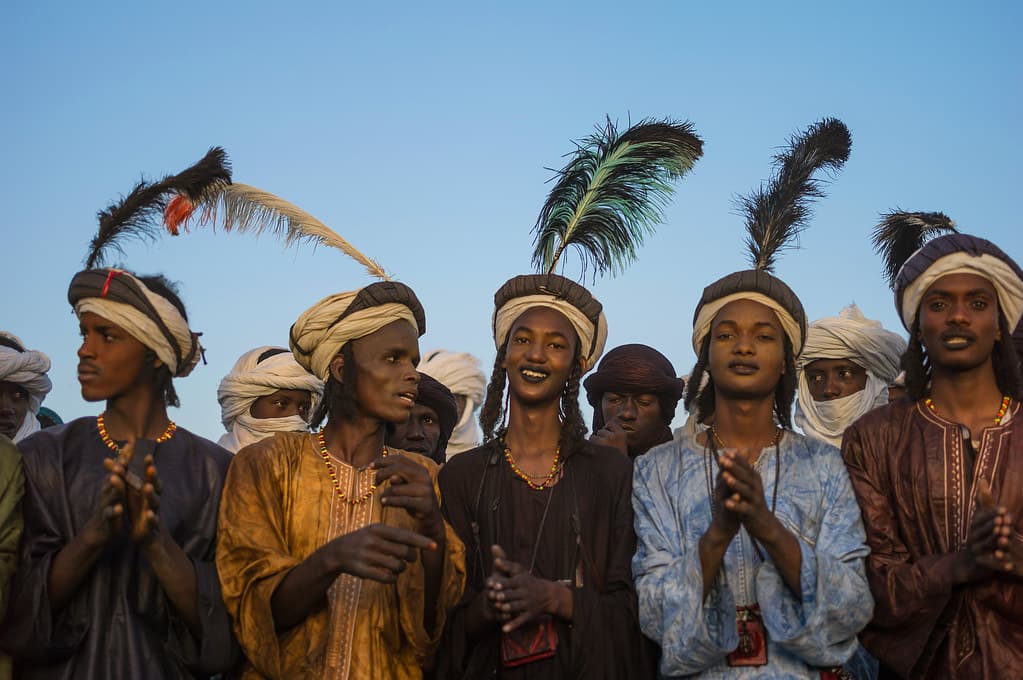
Wodaabe men in ochre paint and brass line up to dance for days; the women choose.
Two dances anchor the gathering, and they are not the same thing. The Yaake is the line of standing men who roll their eyes white and bare their teeth, holding a fixed smile for as long as they can — paleness of eye, whiteness of tooth and symmetry of face are the prized traits, and the dancers whiten their faces and rim their eyes and lips to show them off. The Gerewol proper is a more strenuous, repetitive dance held over several days, at the end of which young women of marriageable age step forward and choose the men they find most beautiful. The men prepare for hours: ochre and yellow on the face, a brass or ostrich-feather crest, beads and a shaved hairline to lengthen the forehead. It is a courtship ritual, but also a contest of stamina and self-presentation in which beauty is a public, judged quality and the judges are women. The gathering closes the herding year and opens the marriage season; for a people spread thin across four countries' worth of Sahel, it is the moment the nation sees itself in one place.
Drawn up by the host community. Please read in full before requesting an invitation.
Witnessed access only, through a host who knows the lineages and can find the moving camp. The gathering has no fixed site; reaching it means days of overland travel from Agadez or Zinder. Check current security advisories before committing.
Loose, covering, light-coloured clothing against sun and dust; a head wrap or scarf. The dancers are the spectacle — visitors dress plainly and stay at the edge.
The Wodaabe are generally open to being photographed, and the men prepare to be seen — but ask each person, and accept a refusal. Do not photograph anyone mid-judging or push a lens into the dancing line.
Stay at the margin of the dance ground and let the women's choosing happen without interference. Accept tea if offered. Move and camp only where your host places you.
Fulfulde. Travel with an interpreter; French is the regional lingua franca in Niger.
Extreme heat and dust at the end of a multi-day overland journey with no medical facilities. Carry rehydration salts, a full personal first-aid kit, and any chronic medication in quantity. Malaria prophylaxis for the wet-season tail.
This is remote Sahel with no infrastructure: you camp. Sun and dust are constant — a head covering, high-SPF sunscreen, a dust scarf and serious water discipline matter more than anything else. A torch, your own shade, and a way to charge a phone off a vehicle. Bring small gifts of tea, sugar or kola only on your host's advice.
There is no auditorium and no fixed ground — you arrive at a camp in open scrub and the dancing forms on bare earth. The men are extraordinary up close: the paint, the rolled eyes, the held grimace that reads as a smile, the slow side-step that goes on far longer than you expect. It is hot, dusty and unhurried, punctuated by sudden intensity when a line of dancers locks in. Women move along the line appraising; the judging is quiet and serious, not theatrical. You are a guest at a courtship, not an audience at a show.
The end-of-rains courtship gathering of the Wodaabe