Mexico· Americas
Nov 18 – Nov 19, 2026
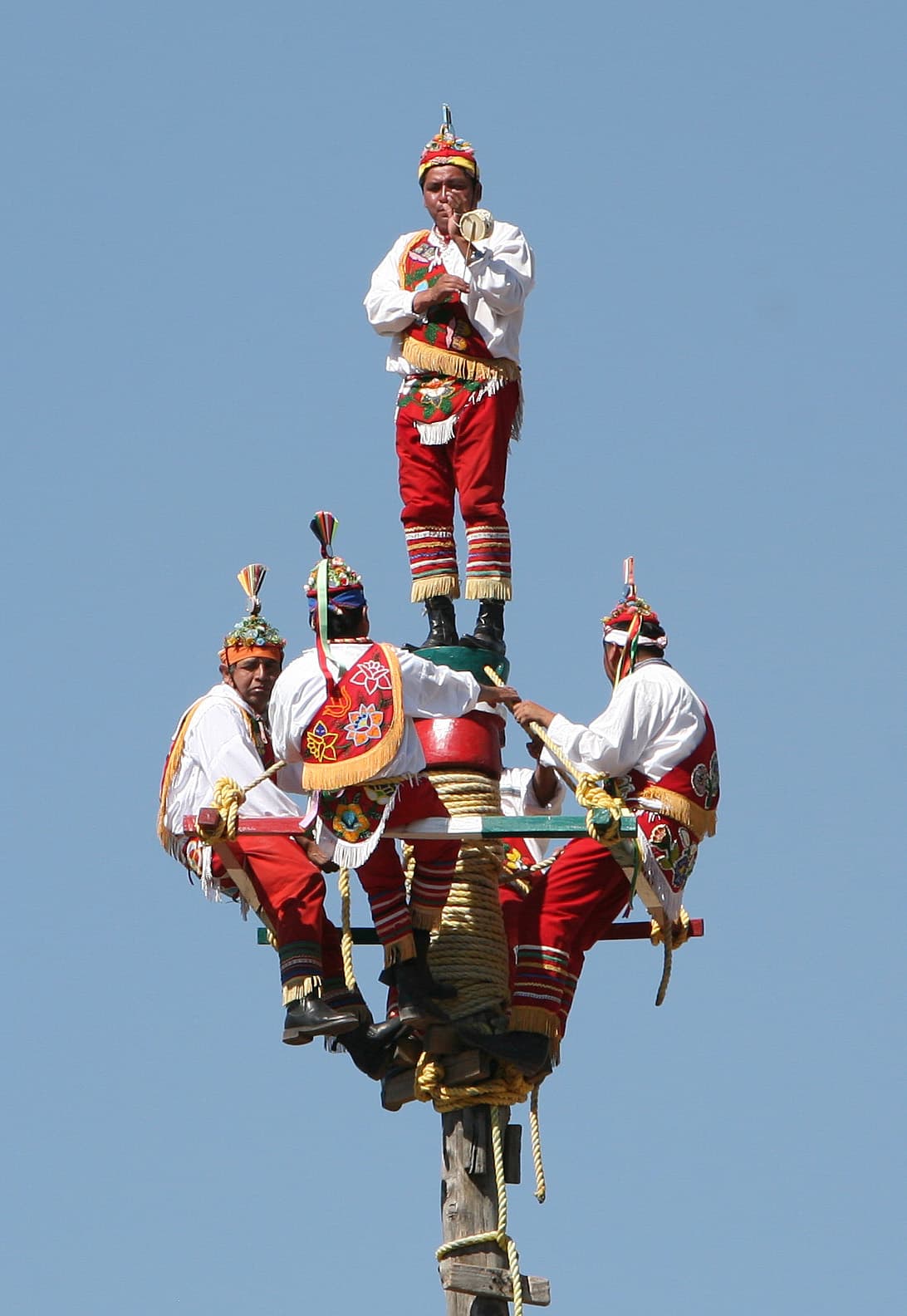
Four men launch backwards from a thirty-metre pole and spiral slowly to earth as a flute plays above.
The ritual ceremony of the voladores is among the oldest surviving rites of Mesoamerica, kept most faithfully by the Totonac of the Veracruz highlands around Papantla and the ancient city of El Tajín. A tall pole — once a tree felled and raised with prayers asking the mountain's pardon — stands at the centre. Five men in red and white, hung with mirrors and feathered headdresses, climb to a small rotating platform at the top. There the caporal stands and plays a flute and small drum, turning to salute the sun and each of the four cardinal directions, while the other four bind their waists to ropes wound around the pole's crown. At the caporal's signal the four launch backwards into space, arms spread, and spiral slowly head-down toward the ground as the unwinding ropes lower them; each makes thirteen revolutions, and four flyers times thirteen turns gives the fifty-two years of the Mesoamerican calendar round. The flight is an offering — a petition for the fertility of the earth and harmony with the sun and the winds — and the caporal's music, played while he balances unroped on the summit, is its devotional core. UNESCO inscribed the rite in 2009, recognising the Totonac performance as the most faithful to its origins. The voladores fly at El Tajín for visitors through the year and most fully at the feast of Corpus Christi in Papantla; the rite is taught in dedicated schools to keep it alive for the next generation.
Drawn up by the host community. Please read in full before requesting an invitation.
Open. The voladores fly through the year at the El Tajín archaeological zone (which charges entry) and in Papantla, and most ceremonially at Corpus Christi. No ticket for the plaza performances; a contribution to the flyers is expected.
Light, modest, practical clothing for heat and sun. No special code at the open-air sites.
Photography is welcomed and the flight is made to be seen. Offer a contribution to the voladores, who rely on it, and ask before close portraits; respect any guidance at the pole-raising rites.
Stand clear of the pole base and the flyers' landing circle, give a fair contribution, and treat the flight as the offering it is rather than a stunt. Don't distract the caporal or the flyers during the ascent.
Totonac and Spanish.
Hot, humid, sunny conditions outdoors; manage sun and water. Otherwise undemanding for spectators. Repellent advised in the humid setting.
The Veracruz lowlands are hot and humid with strong sun: a hat, sunscreen, water and light clothing. The voladores perform outdoors at El Tajín and in Papantla's plaza; bring Mexican pesos in cash, including a contribution for the flyers, who depend on it. Insect repellent for the humid forest setting.
You stand at the foot of the pole and watch five men climb to a platform that looks impossibly small from below. The caporal's flute drifts down as he turns to the four directions; then the four flyers tip backwards and the world inverts — they hang head-down, arms wide, spinning out and down in slow, widening circles as the ropes pay out, the feathers and mirrors catching the light, until they right themselves to land on their feet. It is brief, silent and serene rather than acrobatic, and it reads clearly as prayer once you know what the turns and the music mean.
Four flyers spiralling down from a thirty-metre pole