秘鲁· Americas
Jul 11 – Jul 12, 2026
Tens of thousands climb to nearly 4,800m where Andean mountain worship and Catholic devotion are one rite.
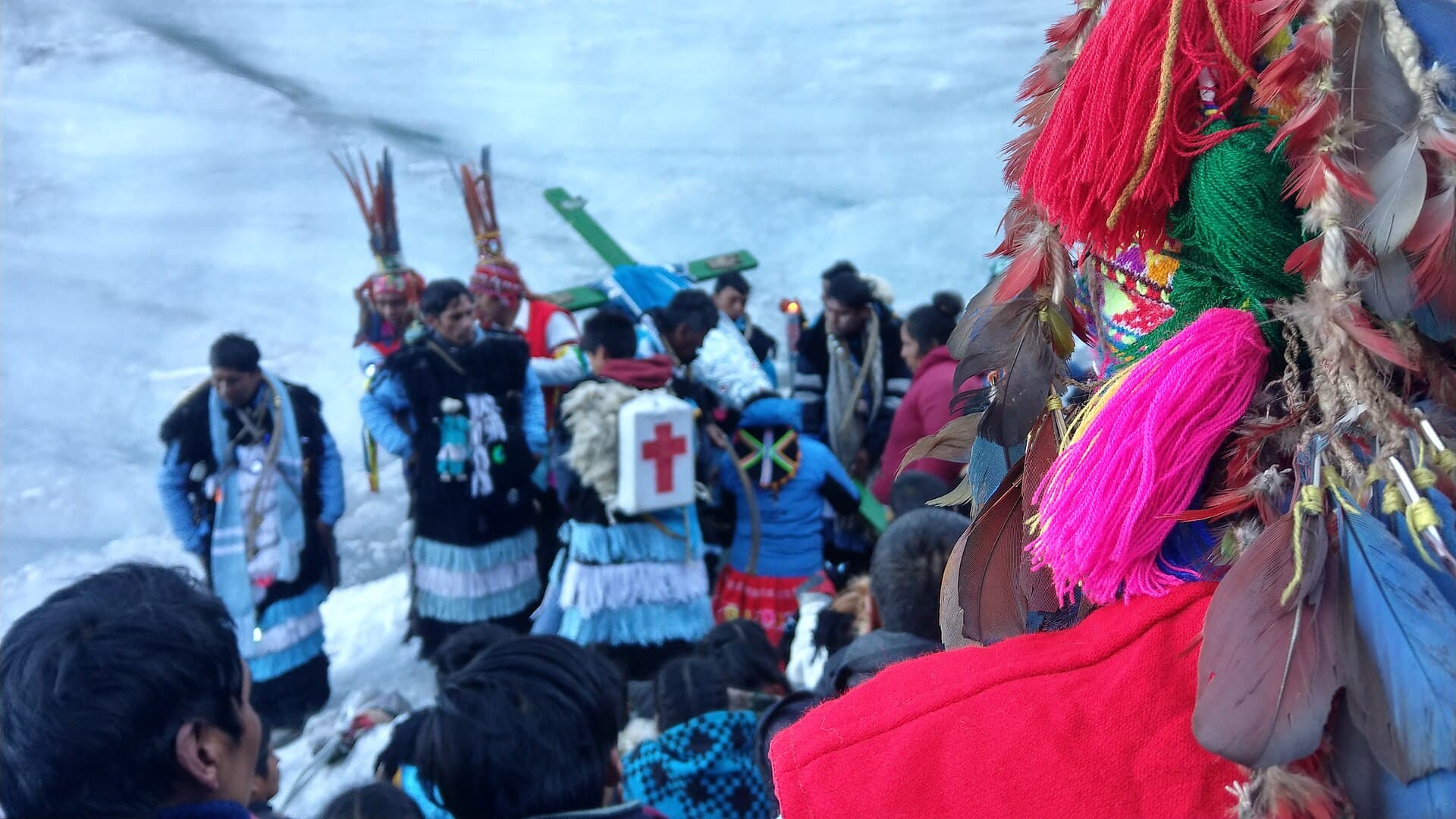
Qoyllur Rit'i is held in the days before Corpus Christi, sixty days after Easter, when the full moon falls — late May or June. Pilgrims gather from the surrounding Quechua 'nations', principally Paucartambo and Quispicanchi, and walk through the night from the trailhead at Mahuayani up to the sanctuary in the Sinakara valley, set at around 4,700 metres beneath the Qullqipunku glacier. There a Christ — the Lord of Qoyllur Rit'i — is venerated on a painted rock, and at the same time the mountain itself is honoured: the two devotions are not separable, and pilgrims hold both at once. The rite's guardians are the Ukukus (or pabluchas), figures dressed as the half-human, half-bear creatures of Andean myth, who police the pilgrimage with whips and humour and, in its central act, climb onto the glacier in the cold dark before dawn. They once cut and carried down blocks of glacier ice, believed to be sacred and medicinal; as the glacier has retreated sharply with climate change, the cutting of ice has been curtailed or stopped, and the Ukukus now bring down crosses set on the ice rather than the ice itself — a living adaptation of the rite to a melting mountain. Around the sanctuary, dances and processions run continuously, comparsas in costume performing for the Lord. It is one of the largest Andean-Christian pilgrimages in the Americas, and it is physically and spiritually demanding in equal measure.
由主办社区拟定。请在请求邀请前完整阅读。
Witnessed, and demanding. The pilgrimage is open but should be undertaken only after acclimatising and with a host experienced at altitude. From Cusco to Mahuayani by road, then several hours on foot to the sanctuary. Some inner devotions are reserved to the brotherhoods.
Practical heavy cold-weather clothing; modest and unobtrusive. This is a devotion, not a trek to be dressed up for — visitors keep a low profile.
Restrained. The encampment, dances and processions may generally be photographed with courtesy, but the glacier ascent and the most sacred moments call for distance and discretion — follow your host and the brotherhoods, and never intrude on prayer.
Keep to the pilgrim paths, defer to the Ukukus' authority over the crowd, and do not set foot on the glacier or interfere with the ascent. Move quietly through devotions, give way to processions, and let the rite proceed as the nations conduct it.
Quechua and Spanish; a bilingual host is important.
Severe altitude (4,700m) with real risk of acute mountain sickness, plus sub-zero nights and heavy exertion on foot. Acclimatise for several days in Cusco beforehand, discuss altitude medication with a doctor, and do not attempt it with heart, lung or pregnancy concerns without medical clearance.
This is the most physically serious entry in the catalogue: a 4,700 m sanctuary reached on foot, freezing nights, and real altitude risk. Acclimatise in Cusco first. Bring serious cold-weather and rain/snow gear, a sleeping bag rated for sub-zero, a headlamp, water, high-energy food, and altitude medication discussed with a doctor. Coca leaf, as the pilgrims use, helps. Carry your own kit — there is nothing to buy up there but the basics.
You climb in the dark and cold with a moving river of pilgrims, candles and headlamps strung up the valley. The sanctuary is a vast, freezing encampment under the glacier, never quiet — dance troupes in costume, brass and drums, processions, the constant motion of the Ukukus keeping order. Before dawn you watch the masked figures ascend onto the ice and return at first light. The altitude makes everything slow and heavy; the devotion around you is intense and entirely unselfconscious. You are a witness in a crowd of the faithful, not an audience.