秘鲁· Americas
Jul 11 – Jul 12, 2026
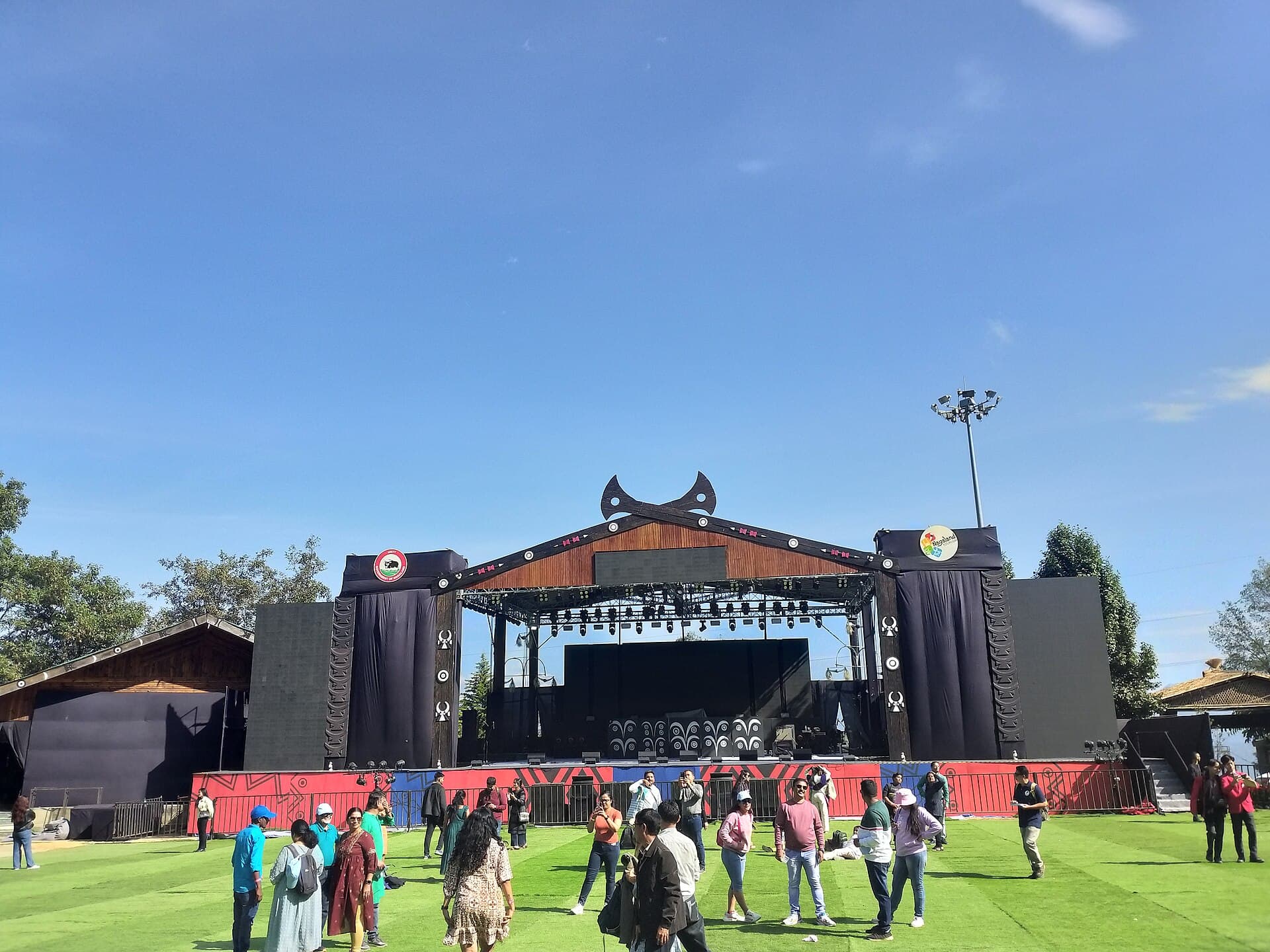
Seventeen Naga tribes gather at Kisama for ten days of warrior dance, log-drum song and craft.
The Hornbill Festival runs from 1 to 10 December at the purpose-built Kisama Heritage Village, about 12 km from Kohima. It is named for the hornbill, the bird whose feathers feature in Naga ceremonial dress and which recurs across the peoples' folklore. Each of Nagaland's seventeen major tribes maintains its own morung at Kisama — a full-scale ceremonial house — and uses it as a base from which to perform its dances, songs, games and rituals and to host visitors over food and rice beer. Across the ten days you see warrior dances, the hauling and beating of the great hollowed log-drums that once carried messages and called villages to gather, mock head-taking displays drawn from the peoples' martial past, wrestling, Naga games, and a running market of weaving, woodcarving and cuisine. The festival was established in 2000 specifically to hold these traditions together: many Naga ceremonies had been weakened by a century of Christian conversion and by the long political conflict in the region, and the state's wager was that a shared annual gathering would let the peoples keep and exchange what remained. That wager has been argued over — some Naga scholars criticise the festival as a packaged, touristic version of living cultures — and the catalogue keeps that tension in view: Hornbill is at once a genuine instrument of preservation and a state-managed showcase, and both things are true at the same time.
由主办社区拟定。请在请求邀请前完整阅读。
Guided and permit-gated. Foreign nationals require a Protected Area Permit (PAP) and Indian nationals an Inner Line Permit (ILP) to enter Nagaland — organise these in advance through a tour operator. Kisama is a short drive from Kohima.
Practical warm clothing; modest dress is appreciated in this largely Christian, conservative state. The regalia belongs to the performers — visitors dress plainly.
Photography is welcomed across the festival. Ask before close portraits of elders and performers in the morungs, and follow any signs at specific rituals.
Accept hospitality in the morungs graciously, ask before joining a dance or handling instruments, and treat the head-taking displays as heritage, not spectacle. Buy directly from the craftspeople to support the communities.
Nagamese and English (Nagaland's official language); each tribe has its own language.
Cold hill weather and a muddy, uneven hillside site over long days; warm layers and sturdy footwear matter. Altitude is moderate. Carry personal medication — Kohima has basic facilities only.
Kohima sits at altitude and early December is cold, especially mornings and evenings — bring warm layers, a jacket and an umbrella for the hill drizzle. Crucially, foreign visitors need a Protected Area Permit and Indian visitors an Inner Line Permit for Nagaland: arrange these well ahead. Cash in rupees, and good shoes for the muddy hillside site.
The site is an amphitheatre ringed by the tribes' morungs. In the arena, groups rotate through dances in full regalia — feathered headgear, spears, shawls whose patterns encode rank and lineage — while the log-drums boom and the crowd circulates between the houses tasting food and watching crafts. Elders sit in the morungs and will talk; younger members perform and host. It is organised and busy, with a real market energy, and you move at your own pace between the formal arena programme and the quieter encounters in the houses.