Papouasie-Nouvelle-Guinée· Oceania
Aug 31 – Sep 1, 2026
Over a hundred groups converge on Goroka in September for the country's oldest sing-sing gathering.
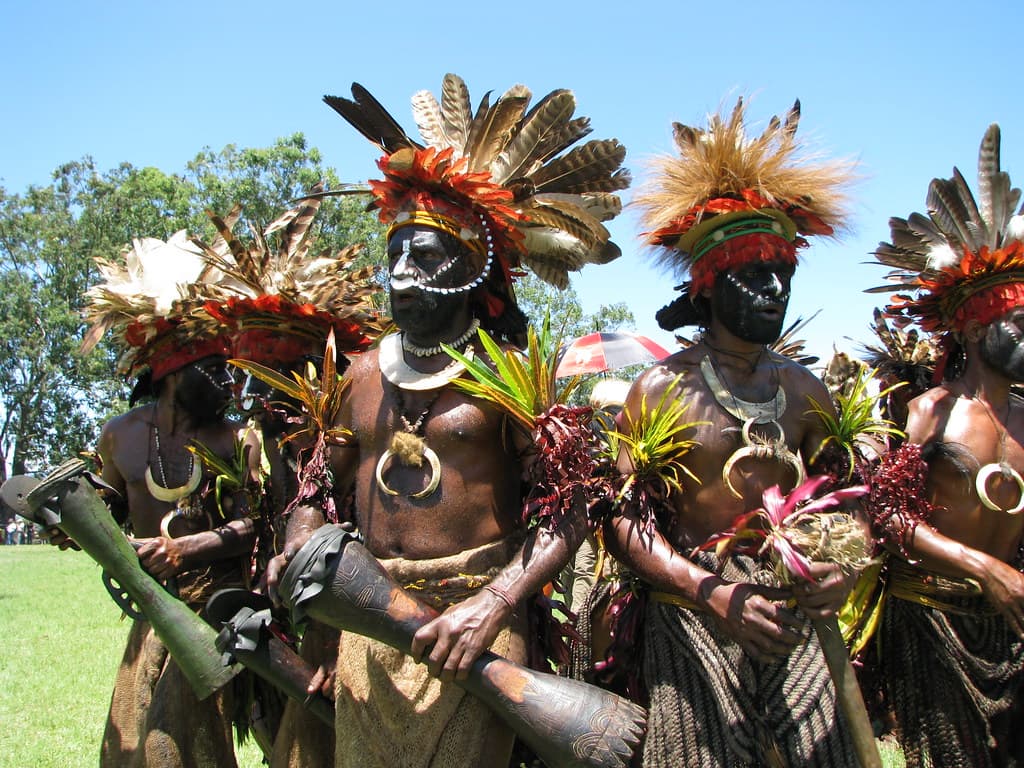
The Goroka Show, held in the Eastern Highlands over the Independence weekend in September, is the older of Papua New Guinea's two great highland gatherings and draws more than a hundred sing-sing groups. Its character mirrors Mount Hagen's — clans in full regalia of plume, paint, shell and bone, dancing in disciplined blocks to the kundu drums — but Goroka has its own roster of peoples and is famous for figures such as the Asaro 'mudmen', who cover themselves in pale clay and wear heavy moulded clay masks, enacting a story of warriors who once frightened off an enemy by appearing as spirits. The show began in the 1950s under the colonial administration as a way to bring highland groups together peacefully, and it has run as the headline cultural event of the Independence celebrations ever since, marking its seventieth year in 2026. As at Hagen, the gathering is both spectacle and transmission: elders dress the young, the regalia and dances are taught and renewed, and each group's turn on the ground is a public claim to identity within a hugely diverse nation. The same honest tension applies — these are living cultures performed in a managed, visitor-facing setting — and the same protected significance attaches to the bird-of-paradise plumes, which are inherited and reused rather than freshly harvested.
Rédigées par la communauté hôte. Merci de les lire en entier avant de demander une invitation.
Guided, as at Mount Hagen. The show welcomes visitors but PNG travel needs planning, a local guide and attention to current advisories. Reached by air to Goroka.
Practical, modest clothing for sun and mud. Visitors dress plainly; the regalia is the groups'.
Photography is welcomed; ask each group before close portraits. The mudmen and plumed groups expect to be photographed but courtesy first is the rule.
Greet before photographing, keep clear of and never touch the regalia, and treat each group's performance as the identity-claim it is. Support the craft and food stalls directly.
Tok Pisin and English; many local languages.
Highland sun, heat and possible rain over long days on grass; sun/rain cover and sturdy shoes needed. Limited medical care — carry a personal kit; malaria precautions for lowland transit.
As for Mount Hagen: sun and rain cover, water, closed shoes for grass, and kina in cash. September is warm and sunny with possible rain. A local guide handles transport and safety; bring a personal first-aid kit and any medication.
Goroka's showground fills with groups assembling from dawn — the Asaro mudmen among the most striking, moving slowly behind blank clay masks. The arena fills with blocks of dancers, each distinct in paint and plume, the drums overlapping into a continuous pulse. As at Hagen you can get close in the staging areas, watch the regalia go on, and talk with the groups. Held over the Independence weekend, it carries an added national charge. Hot, bright, crowded, and yours to navigate at your own pace.
The great highland gatherings of feather, paint and song