Pérou· Americas
Jul 11 – Jul 12, 2026
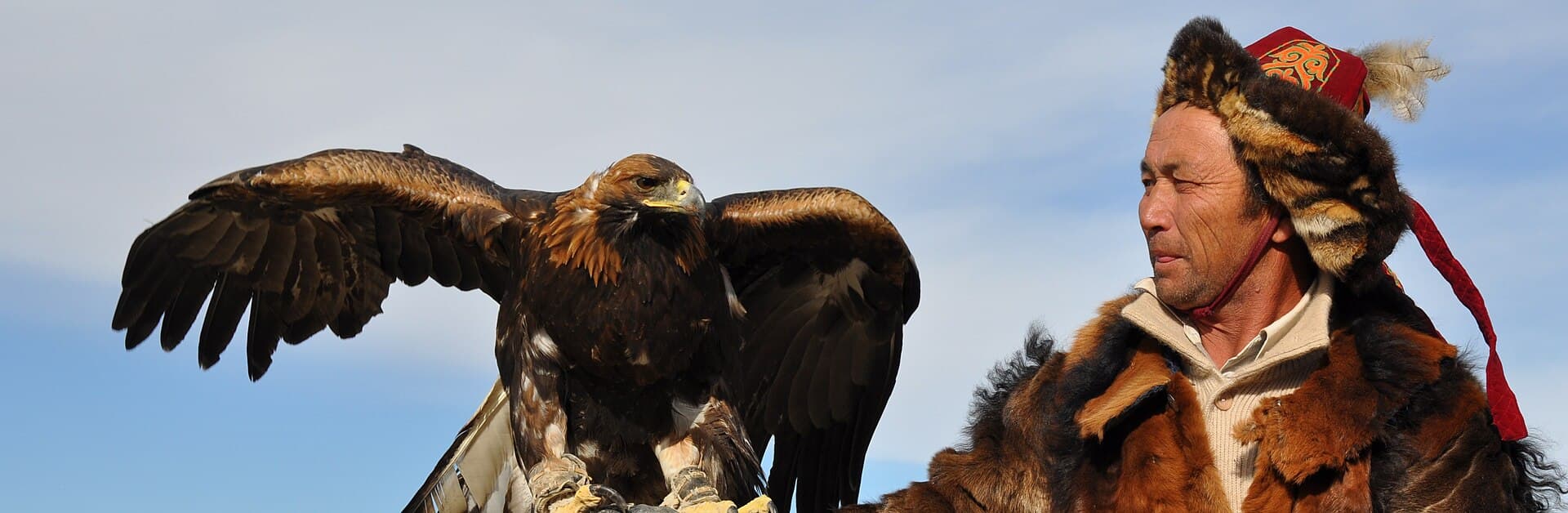
Eagle hunters in fox-fur and horseback call their golden eagles down from the Altai ridgelines to the glove.
The Golden Eagle Festival gathers up to eighty berkutchi outside Ölgii on the first weekend of October, on open ground ringed by the snow-edged Altai. Over two days the hunters compete in the skills of their craft: riding out in full kit — embroidered coats, fox-fur hats, the heavy gloved arm — they release their eagles from a ridge or perch and are judged on how fast and surely the bird answers the call and stoops to the glove or to a dragged lure. There are events for speed, for accuracy, and for the eagle's response to its hunter's voice, alongside Kazakh horse games — kokpar, a tug-of-war over a goat carcass, tenge alu, snatching coins from the ground at a gallop — camel racing and archery. The eagles are female (larger and stronger than the males), taken as eaglets, trained patiently over years, hunted with through the winters for fur, and then, by custom, freed to breed in the wild. The festival was begun in the 1990s partly to sustain a tradition that had thinned under decades of state socialism, and it now anchors the cultural identity of the Mongolian Kazakhs and their winter livelihood. It draws hunters down from remote valleys and visitors from around the world, but the skills on show are the working skills of a hunting people, not a performance invented for an audience.
Rédigées par la communauté hôte. Merci de les lire en entier avant de demander une invitation.
Guided. The festival is organised for visitors but reaching Bayan-Ölgii needs planning — a flight from Ulaanbaatar to Ölgii, then ground transport. A local host arranges seating, ger accommodation and visits to hunters' families.
Heavy warm, windproof clothing. No formal code; the hunters wear the regalia, visitors dress for the cold.
Photography is welcomed and the hunters expect photographers. Ask before close portraits and before handling near the eagles, and don't crowd the birds, which are working animals sensitive to commotion.
Keep back from the eagles unless a hunter invites you closer, and never grab at a bird or its lure. Treat the horse games' edge and the hunters' space with respect, and support the families who host and feed visitors.
Kazakh and Mongolian; guides speak English.
Hard cold, wind and high-altitude sun over exposed days; dress for sub-freezing standing. Bayan-Ölgii is remote with limited medical care — carry a personal kit and any medication.
Early October in the Altai is cold and windy, often around or below freezing with the chance of snow — serious warm layers, windproof outer, hat, gloves and warm boots are essential. The festival ground is open steppe with no shelter; bring sun protection too, plus Mongolian tögrög in cash and any medication, as Ölgii is remote.
On a cold, bright steppe morning the hunters ride in, eagles hooded on their arms, and take turns climbing the slope to release the bird while the hunter calls from below — sometimes the eagle drops straight to the glove, sometimes it circles and tests the wind. Up close the birds are huge, the kit intricate, the horsemanship offhand and total. Between flights the horse games erupt in dust and shouting. It is freezing, windy and exhilarating, and the hunters are glad to talk and show their eagles.
Hunting with golden eagles from horseback in the Altai